

The Commercial, Industrial, and Institutional (CII) Permit Summary and Updates
On July 23, 2026, the Los Angeles Regional Water Quality Control Board (LA Water Board) approved the revised Commercial, Industrial, and Institutional (CII) Storm Water Permit. The permit establishes storm water management, monitoring, and compliance requirements for certain privately owned facilities located within the Dominguez Channel, Los Angeles and Long Beach Inner Harbor, and Los Cerritos Channel/Alamitos Bay watersheds. The permit is scheduled to take effect on October 31, 2026.
The CII Permit will affect commercial, industrial, and institutional facilities that meet the following criteria:
- Located within the Dominguez Channel, Los Angeles and Long Beach Inner Harbor, or Los Cerritos Channel/Alamitos Bay watersheds;
- Falls within one of the following LA County Tax Assessor land use codes: 1000–2900, 3000–3920, 6000–6910, 7000–7710, and 8100–8400;
- Privately owned; and
- Meets one of the following criteria based on size and current permit coverage:
- Five or more acres of impervious surface and are not already covered by another National Pollutant Discharge Elimination System (NPDES) permit; or
- Five or more total acres and are already covered by another NPDES permit [such as the Industrial General Permit (IGP)], including:
- Facilities that have filed a No Exposure Certification (NEC) under the IGP; or
- Portions of a facility excluded by a Notice of Non-Applicability (NONA).
Note: If a facility has a site-specific NPDES permit with requirements that are at least as stringent as those outlined in the CII Permit, then that facility is not required to obtain coverage under the CII Permit.
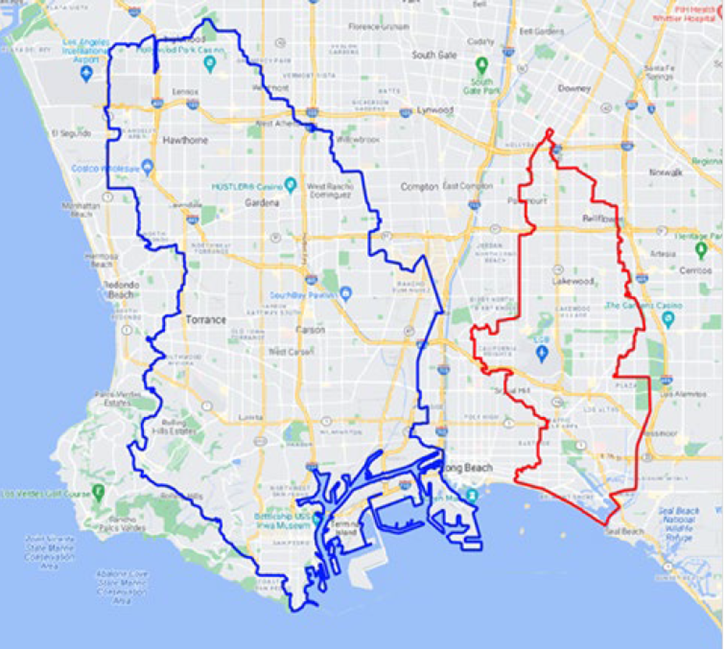
Dominguez Channel – Greater Los Angeles and Long Beach Harbor (blue).
Los Cerritos Channel – Alamitos Bay (red).
Permit Requirements
Facilities subject to the CII Permit will be required to take the following steps to achieve compliance with the permit requirements:
- File a Notice of Intent (NOI) in the Storm Water Multiple Application and Report Tracking System (SMARTS);
- Prepare a Storm Water Pollution Prevention Plan (SWPPP) and Monitoring Implementation Plan (MIP);
- Choose one of the following three compliance options:
-
- Option 1: Off-Site Compliance Agreement with local watershed management group (Water Board recommended);
- Option 2: On-Site Compliance Site-Specific Design Standard to reduce storm water runoff; or
- Option 3: On-Site Compliance Demonstration;
- Pay the annual permit fee; and
- Complete a one-time initial sampling consisting of the following parameters: ammonia, biochemical oxygen demand (BOD), indicator bacteria, methylene blue activated substances (MBAS), nitrogen/biostimulatory substances, oil and grease, polyaromatic hydrocarbons (PAHs), pesticides, pH, temperature, total residual chlorine, total suspended or settleable solids, zinc, and copper.
Timing of Permit Enrollment
The CII Permit will become effective 100 days after adoption. The motion to adopt was approved on July 23, 2026, meaning that the estimated effective date is October 31, 2026. Based on the estimated effective date, the schedule for facility enrollment is as follows:
- NOI and SWPPP: Within 12 months of the effective date (by October 31, 2027);
- Initial Sampling Results: Within 18 months of the effective date (by April 30, 2028); and
- Compliance Option Documents: Within 3.5 years of the effective date (by April 30, 2030).
________________________________
Yorke Engineering has assisted over 2,000 industrial and government facilities across California with EH&S consulting and air quality consulting, as well as permitting and compliance for storm water, wastewater, hazardous waste, industrial hygiene, and safety programs. Learn more here: Services – Yorke Engineering, LLC
If you would like a proposal, click the button below.